The pressure on UK agencies isn’t easing — it’s changing shape
UK agencies don’t need another “the market is tough” headline in 2025 - you’re living it every day. What has shifted over the last 12–18 months is not just the level of pressure, but the combination of forces arriving at once. Clients are still investing in marketing, digital and production, but they are doing so with far greater scrutiny. Budgets are tighter or more fluid, decision-making timelines are longer, procurement is more involved, and work is increasingly broken into smaller, test-and-learn engagements. Expectations on quality, speed and accountability, however, have not softened.
At the same time, agencies are carrying a steadily rising internal cost base. Employment costs continue to increase, management overheads are heavier, tools and platforms are more expensive, and office commitments in the UK remain significant. Put simply, it has become harder to maintain historic margins using a traditional, UK-only delivery model — particularly if revenue is uneven or pipeline visibility is short.
Resilience is becoming the real competitive advantage
In this environment, the agencies that remain confident are not necessarily those with the loudest growth stories. They are the ones that have quietly built resilience into their operating model. When demand slows, they can absorb the pressure without destabilising teams. When opportunities return, they can scale quickly without scrambling to rehire or rebuild capability.
That’s why the conversation has moved away from short-term cost cutting and towards longer-term structural flexibility. Leaders are asking harder questions: How do we protect delivery quality when revenue fluctuates? How do we avoid over-hiring in the good times and over-correcting in the bad? How do we build an agency that can ride cycles rather than react to them?
Why South Africa — and why now?
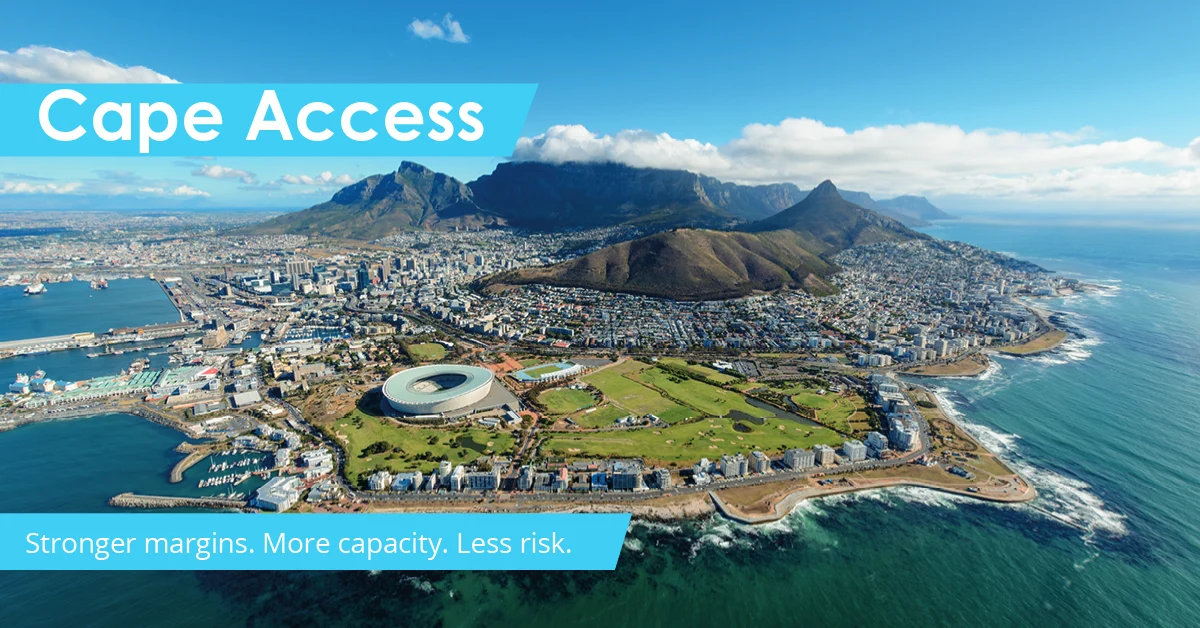
Increasingly, that flexibility is coming from adding a second delivery hub outside the UK — not as a bolt-on outsource, but as a genuine extension of the agency. And for UK digital, media, marketing and production agencies, South Africa, and Cape Town in particular, has emerged as a compelling option.
One reason is simple practicality. South Africa’s time-zone alignment allows teams to work in real time with the UK, supporting the pace and responsiveness clients expect. Live collaboration, shared stand-ups and same-day turnaround all remain possible. For agencies used to operating at speed, this avoids the friction that can come with more distant offshore models.
Another reason is cultural, and communication fit. English is widely used in business, and South Africa has a strong professional services heritage, with teams accustomed to working with international clients. This makes it easier to integrate offshore colleagues into existing delivery rhythms and, where appropriate, client-facing work. The goal isn’t to create a separate engine running in parallel, but a single team operating across two locations.
Talent, education and long-term depth
Talent depth is a critical factor. South Africa has a strong education system with well-regarded universities and a steady pipeline of graduates across creative, marketing, digital, technical and operational disciplines. Many professionals are globally minded, ambitious and career-focused - exactly what agencies need if an offshore hub is to become a long-term asset rather than a revolving door.
Combined with a strong standard of living and lifestyle, particularly in Cape Town, this supports retention and continuity. A stable team doesn’t just reduce recruitment churn - it improves delivery quality, speeds up onboarding, and strengthens institutional knowledge over time.
The commercial reality: changing the margin equation
Commercially, the model can be transformative. Salary and office costs are structurally lower than in the UK in a way that meaningfully changes the margin equation.
Roles that might command £60–70k base salary in London can often be filled in Cape Town at the equivalent of £15–20k, delivering savings of 55–65% on salary alone. Office costs show a similar pattern: London desk costs of £750–£1,100 per month compared to roughly £120–£200 per desk in Cape Town, representing 70–85% savings.
These differences give agencies the ability to build broader, better-balanced teams without carrying the same financial strain. This isn’t about lowering standards; it’s about unlocking capacity - resourcing work properly, reducing bottlenecks, and freeing senior UK talent to focus on strategy, creative leadership and client relationships.
Flexibility matters more than ever in an uncertain market
The most powerful benefit, however, is flexibility. In 2025, revenue patterns are less predictable. A strong pipeline in one quarter can soften quickly if a client pauses or reprioritises.
When your delivery model is built entirely on a high fixed-cost UK base, those swings force uncomfortable decisions - hiring freezes, redundancies, or capability gaps that take months to repair. A lower-cost hub changes that dynamic. It gives agencies more room to manoeuvre.
If revenue dips, you are more likely to keep your team intact, preserving skills, institutional knowledge and momentum. When confidence returns, you can respond immediately rather than rebuilding from scratch. Over time, that ability to stay ready becomes a competitive advantage. Resilience stops being defensive and starts enabling growth.
Cape Town as a destination, not just a delivery centre
Cape Town also stands out because it is a place people want to build their lives. That matters. A hub works best when people are invested, engaged and proud of the work they’re doing.
For UK leadership teams, it also means the hub is somewhere you will visit. Regular leadership presence strengthens culture, alignment and trust, all of which dramatically increase the odds of long-term success.
A balanced view: the risks are real — but very manageable
Most UK agencies are already fluent in distributed working. Since Covid, you’ve built the muscle memory: leading teams you don’t sit next to, running projects across locations, and keeping standards high without relying on physical proximity. So, the biggest risks in building a South Africa hub aren’t about day-to-day remote delivery — they’re about the upfront, structural choices that shape the experience over time.
The first is getting the foundations right: selecting credible local partners, setting up compliant employment and payroll arrangements, and understanding local norms from the outset. The second is hiring for longevity rather than speed - building a team that sees a future with the agency, not just a short-term role. The third is operational clarity: clear ownership, decision-making authority and accountability across two locations, so leadership time isn’t lost to ambiguity.
Integration is another critical consideration. Not because agencies can’t manage remote teams - they already do - but because the aim is to avoid creating a “second team” that feels peripheral. The strongest hubs share the same standards, language and ambitions as the UK business. Early alignment on tools, ways of working and shared goals ensure the hub becomes part of the agency’s identity, not an add-on.
Building for the next cycle, not just the next quarter
Ultimately, this isn’t about chasing a short-term margin fix. It’s about building a modern agency designed for volatility: one that can absorb market uncertainty, protect its people, and still move quickly when opportunity appears.
South Africa offers a rare combination of talent, lifestyle, accessibility and economics that makes that possible. For agencies looking beyond the next quarter and thinking seriously about long-term strength, a Cape Town hub isn’t a compromise. It’s an operating advantage, and increasingly, a smart one.